A telescope made of ice: catching neutrinos from deep space
Awarded to Francis Halzen “for decisive contributions to the IceCube Neutrino Observatory and the discovery of high-energy neutrinos of astrophysical origin”.
1Pick your depth
What was the 2026 Nobel Prize in Physics awarded for?
The 2026 Physics prize goes to Francis Halzen, who saw that the clear ice under the South Pole could be used to catch neutrinos, particles that almost never touch matter. He led the building of IceCube, a cubic kilometre of ice deep below the surface fitted with 5,160 light sensors. In 2013 it found the first high-energy neutrinos from far outside our solar system, which opened a new way to study the most violent places in the universe.
2Guess first
Cosmic rays, mostly protons, have been hitting the Earth since long before we found them in 1912. Some carry far more energy than any machine on Earth can give a particle. Why can't astronomers just look back along their path to see where they came from?
How close were you?
IceCube is a telescope for the sky, yet many of its searches keep only particles coming up from below, through the whole planet. Why look at the ground to see the stars?
How close were you?
3Learn it at ELI5
Read the transcript
On Christmas Eve 1993, Francis Halzen sat at dinner with a computer on his lap. His team was lowering light sensors into South Pole ice. They hoped to catch neutrinos. Every second, about 65 billion from the Sun pass through your fingernail. Rarely, one bumps into the ice and makes a tiny blue flash. The sensors see it. His detector, IceCube, traced one neutrino to a faraway galaxy with a giant black hole at its heart. For that ice telescope, Halzen receives the 2026 Nobel Prize in Physics.
Neutrinos are tiny particles that fly through almost everything. Right now, billions of them from the Sun are passing through your fingernail every second, and you feel nothing. Some neutrinos come from much farther away, from wild places in deep space where matter is thrown about with enormous force.
To catch one, you need a lot of stuff, because a neutrino only bumps into an atom once in a very long while. When it does, it makes a tiny flash of blue light. Think of a huge dark room with cameras hanging everywhere, waiting for one firefly to blink. If enough cameras see the blink, you can tell where the firefly flew from.
Use the ice as the dark room
Francis Halzen saw that the thick, clear, dark ice at the South Pole could be that room. His team hung thousands of light sensors deep inside it.
This giant ice detector is called IceCube. It caught neutrinos from far outside our solar system, so we can now study space with a new kind of messenger.
Read the transcript
In 1987, at a talk in Kansas, a glaciologist told Francis Halzen about Soviet plans to catch neutrino radio signals in Antarctic ice. Halzen thought of light sensors instead. The first sensors sat too shallow, where air bubbles scattered the light. Deeper down, the ice was clear, snow that fell about 50,000 years ago. A neutrino that hits a nucleus there makes a charged particle that outruns light in ice. It trails a cone of blue Cherenkov light, and sensor timing gives its direction. In 2017, IceCube traced one neutrino to a flaring blazar. An alert went out within a minute, and telescopes worldwide turned to look. Halzen's 1987 idea of light sensors in the ice won him the 2026 Nobel Prize in Physics.
The cosmos has natural particle accelerators. The press release says they fire out particles with up to a million times more energy than any lab on Earth can reach. We have measured these cosmic rays for over a century, but we still do not know where the most energetic ones are made. They are mostly protons, so magnetic fields in space bend their paths and scramble their directions.
A neutrino offers a way around this. When fast protons crash into gas or light near their source, they make short-lived particles called pions. Charged pions decay into neutrinos. A neutrino has no charge and hardly ever interacts, so it travels in a straight line, does not lose energy, and escapes even from places too thick for light to leave.
A streak of blue light in the ice
Very rarely, a neutrino hits a nucleus in the ice and makes a charged particle such as a muon. That particle moves faster than light can travel in ice, so it gives off a cone of blue Cherenkov light, like the bow wave of a fast boat. Sensors record how many photons arrive and when. The count gives the energy and the arrival times give the direction.
IceCube hangs 86 strings of 60 sensors each, at depths between 1450 and 2450 metres, filling a cubic kilometre of ice. A muon neutrino leaves a long straight track that is good for direction. Other events make a round burst called a cascade, which is good for measuring energy. The hard part is the background: muons and neutrinos made by cosmic rays in our own atmosphere. Astrophysical neutrinos stand out because they reach much higher energies.
Read the transcript
In 2013, IceCube physicists searching for the most energetic neutrinos found 2 by chance, each carrying about a quadrillion electron volts. They named them Bert and Ernie. Cosmic-ray protons carry charge, so magnetic fields scramble their paths. At their sources they make charged pions, which decay into neutrinos that fly straight to Earth. In 1988, Francis Halzen and John Learned proposed a detector in polar ice. IceCube became that detector, a cubic kilometre of deep Antarctic ice holding 5,160 sensors on 86 cables. More than 100 million atmospheric muons arrive every day, against about 100 neutrinos a year from space. Keeping only up-going tracks turns the Earth into a shield. For events that start inside the ice, an outer veto shell rejects them. The next step, IceCube-Gen2, is planned to fill 8 cubic kilometres of ice.
The physics case rests on hadronic production at cosmic-ray accelerators. Accelerated protons hit ambient gas (pp) or photon fields (pγ). In pγ the Δ+ resonance decays to pπ0 or nπ+; the π0 gives two gamma rays and the π+ gives νμ plus μ+, which then decays to e+νeν̄μ. The pion takes about 20% of the proton energy and each neutrino ends up with roughly 5%. So protons at 1015 to 1018 eV map onto neutrinos from tens of TeV to tens of PeV, and the gamma-ray and neutrino energy fluxes are tied by the charged-to-neutral pion ratio Kπ (about 2 for pp, about 1 for pγ).
Tiny cross-section, steep spectrum
At PeV energies the neutrino-nucleon cross-section is only about 10-33 cm2, and the expected astrophysical spectrum falls roughly as E-2.5. Practical event rates therefore need a target of about a gigatonne. IceCube's 86 strings carry 60 downward-facing 25.4 cm photomultipliers each, spaced 17 m vertically on a 125 m triangular grid.
Detection is deep inelastic scattering on nucleons, followed by Cherenkov emission from the charged secondaries (ice index about 1.31). Below about 2100 m the absorption length is about 200 m and the scattering length about 50 m. Charged-current νμ events give tracks with 0.3° angular resolution at 100 TeV, but energy known only to a factor of about 2, since the muon may be born far outside the array. Cascades from νe, ντ and neutral-current events are under 10 m long, so direction degrades to about 5° while contained energy resolution reaches about 8% at 100 TeV.
Two backgrounds must be beaten. Down-going atmospheric muons arrive at about 3 kHz; selecting up-going tracks, with the Earth as a shield, cuts them to the μHz level. The roughly 100,000 atmospheric neutrinos per year above 0.1 TeV fall as about E-3.7, so the astrophysical flux of about E-2.5 rises above them beyond a few tens of TeV, for an expected ~100 astrophysical events a year. The starting-event method adds an outer veto shell around a ~500 Mt inner volume. It found two PeV events (1.04 and 1.14 PeV) by chance in 2010 to 2012 data during a search for EeV neutrinos, then 28 events from 30 TeV to 1.14 PeV. In 2014 a purely atmospheric origin was rejected at 5.7σ.
What the flux has shown since
- The combined track and cascade spectrum favours a broken power law; one power law over 5 TeV to 10 PeV is rejected at more than 4σ.
- Arrival directions are isotropic, which points to mostly extragalactic sources.
- Galactic-plane emission was seen at 4.5σ in 2023 and 5.7σ in 2026, from cosmic rays hitting interstellar gas.
- TXS 0506+056: a ~290 TeV neutrino in 2017 landed within 0.06° of a flaring blazar. NGC 1068: 79 neutrinos at 1 to 10 TeV, a 4.2σ excess, pointing to its gas-wrapped core.
- Seven astrophysical tau neutrinos (2024) reject a zero tau flux at 5σ.
Bert and Ernie, found by accident
The first two cosmic neutrinos with more than 1 PeV of energy turned up in 2013 while the team was searching for something else, neutrinos a thousand times more energetic still. The pair were nicknamed Bert and Ernie after the Sesame Street characters. Halzen says the clear ice that made it all possible was pure luck: it is snow that fell on Antarctica some 50,000 years ago.
4Check yourself
Why are neutrinos better than cosmic-ray protons for finding cosmic accelerators?
What does IceCube actually detect?
The first attempts at the South Pole were disappointing. What was the problem with the upper ice?
Key terms
- Neutrino
- A particle with no electric charge and almost no mass that very rarely interacts with matter. It comes in three types and can pass through the whole Earth.
- Cosmic rays
- Charged particles from space, mostly protons and helium nuclei, that constantly hit the Earth's atmosphere. The most energetic ones far outstrip anything made in a lab.
- Cherenkov light
- Blue light given off when a charged particle moves through a material faster than light travels in that material, similar to a boat's bow wave.
- Pion
- A short-lived particle made when fast protons collide with matter or light. Charged pions decay into neutrinos and neutral pions decay into gamma rays.
- Track and cascade
- The two main event shapes in IceCube. A track is a long straight muon path, good for direction. A cascade is a compact round burst of light, good for energy.
- Blazar
- An active galaxy whose jet of fast particles, launched near a supermassive black hole, points almost straight at Earth.
- PeV
- Petaelectronvolt, 1015 electronvolts. IceCube's top neutrinos carry energies in this range.
The laureate
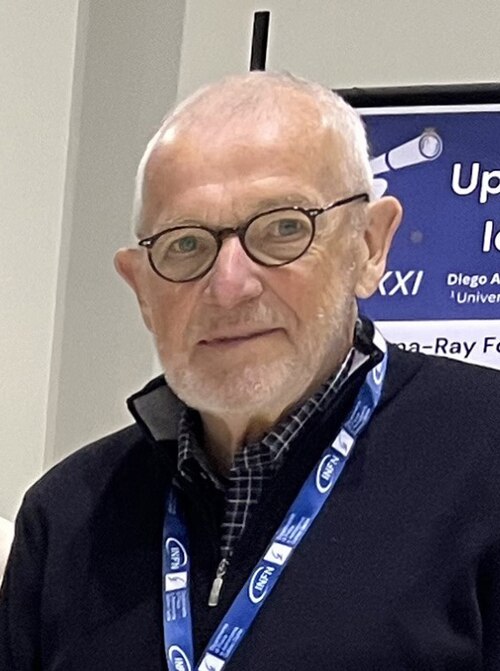
Born in Tienen, Belgium, in 1944, Halzen earned his PhD in Belgium in 1969 and worked at CERN before joining the University of Wisconsin-Madison in 1972. A particle physicist by training, he turned to particles from space. In 1988 he and John Learned first proposed a neutrino detector in South Pole ice, and he then led AMANDA and IceCube as principal investigator from idea to discovery.
Sources
Facts are pinned from the official Nobel Prize API. The explanations were written from these sources:
- The Nobel Prize in Physics 2026, popular science background (NobelPrize.org)
- The Nobel Prize in Physics 2026, press release (NobelPrize.org)
- Scientific background to the Nobel Prize in Physics 2026 (NobelPrize.org, pdf)
- Francis Halzen, first reactions telephone interview (NobelPrize.org)
- Francis Halzen (Wikipedia)
- IceCube Neutrino Observatory (Wikipedia)