Mirror molecules: how a tiny lead in handedness takes over
Awarded to Henri B. Kagan and Kenso Soai “for the discovery of non-linear effects and autocatalysis in asymmetric organic synthesis”.
1Pick your depth
What was the 2026 Nobel Prize in Chemistry awarded for?
The 2026 Chemistry prize goes to two chemists who showed how a reaction can pick one of two mirror-image molecules and stick with it. Henri Kagan found that a catalyst can make a product purer in one hand than the catalyst itself. Kenso Soai built a reaction whose product makes copies of itself, so a lead too small to measure grows until one hand fills the flask. That is how drug makers get the one mirror image that heals, and a working model for how life became one-handed.
2Guess first
You build a catalyst from a chiral ingredient that is only partly pure: mostly the right-handed form, with some left-handed form mixed in. Will the product be less pure, exactly as pure, or more pure than that ingredient?
How close were you?
Soai runs his self-copying reaction starting from ingredients with no handedness at all, 37 times in a row. What do you expect to come out?
How close were you?
3Learn it at ELI5
Read the transcript
A left glove never fits your right hand. Each hand is the other's mirror image. Many molecules come in 2 shapes like that. In a reaction found by Kenso Soai, each new molecule builds another of the same hand. Left and right ones that meet pair up and stop working. So a tiny lead for one hand keeps growing, until almost every molecule in the jar has the same hand. He shares the 2026 Nobel Prize in Chemistry with Henri Kagan, who showed that mixed pairs slow down.
Hold up your two hands. They match, yet you cannot lay one perfectly on top of the other. Many molecules come in the same two versions, a left hand and a right hand. Your body builds its proteins from only one hand.
Now picture a strange glove factory where every glove helps build another glove of the same hand. A left glove makes a left glove. A right glove makes a right glove. When a left and a right glove bump into each other, they get stuck together and stop working.
Start the factory with just a few more left gloves than right ones. The right gloves get tied up in stuck pairs. The spare left gloves keep copying themselves. Soon it makes almost nothing but left gloves.
A tiny lead can win everything
Henri Kagan showed that mixed pairs really do slow down, so a small lead grows. Kenso Soai built a real reaction where the product copies itself, so a lead too small to measure takes over the whole flask.
Read the transcript
In 1953, the Bristol physicist Charles Frank showed on paper how one mirror image of a molecule could take over. He suggested a lab demonstration might just work. In 1986, Henri Kagan showed that a catalyst's metal often holds 2 chiral partners, molecules that come in left and right hands. If the mixed-hand pairs run slowly, the product comes out purer than the partners. In 1995, Kenso Soai found a zinc reaction whose product catalyses its own formation. He seeded it with product at a 5% excess of one hand and fed each batch into the next run. After 5 runs, the excess stood at 90%. Chemists now use Kagan's non-linear effect to tune catalysts for purer medicines and farm chemicals.
A chiral molecule has a mirror image it cannot be laid on top of, like a left and a right hand. The two forms are called enantiomers. Chemists measure how lopsided a mixture is with the enantiomeric excess (ee): the difference between the two amounts divided by the total. A 50:50 mix has 0% ee; one pure hand has 100%.
This matters because living things are homochiral. Proteins use one hand of amino acids and DNA uses one hand of sugar, and a drug's mirror image can act very differently. The thalidomide disaster of the early 1960s was traced to the mirror image of the active substance. Yet ordinary reactions that make chiral molecules from non-chiral ones give an even mix.
Frank's three conditions
The Bristol physicist Charles Frank showed on paper that one hand can take over if three things hold: a chiral catalyst that favours one hand, some way for the two hands to hold each other back, and a product that is its own catalyst (autocatalysis). He ended by noting that a laboratory demonstration might not be impossible.
Kagan supplied the second condition in 1986. Many asymmetric catalysts are a metal plus a chiral partner, and chemists assumed the product's ee tracked the partner's ee in a straight line. Kagan reasoned that the metal often holds two partners. A partly pure partner then forms right-right, left-left and mixed catalysts. If the mixed one is slow, it ties up the minority hand and the product ends up purer than expected. He reported this curve, a non-linear effect, in three different reactions.
Soai supplied the third. Adding diisopropylzinc to a pyrimidine aldehyde gives a chiral alcohol that catalyses its own formation. In 1995 he started with the alcohol at 5% ee and fed each run's product into the next.
Soai's 1995 amplification, run by run
Enantiomeric excess of the chiral alcohol. Each run's product seeds the next run.
Read the transcript
In 2001, the Nobel for asymmetric catalysis went to 3 chemists. Henri Kagan was not one of them. At 95, he now shares the 2026 prize with Kenso Soai. His 1986 paper broke a linear assumption. A metal holding 2 partly pure ligands forms same-hand and mixed-hand pairs. If the mixed pair is slower, the product ends up purer than the ligand. The paper found this positive non-linear effect in the Sharpless epoxidation of geraniol. Soai's reaction couples this gain to asymmetric autocatalysis. Its zinc alkoxide product catalyses its own formation, which meets the conditions Charles Frank set out in 1953. By 2003, a seed with an excess of about 1 part in 2 million gave product above 99.5% after 3 runs. In 2015, Soai's group solved X-ray structures of the zinc alkoxide tetramers, 2 zinc-oxygen squares joined into a 12-membered ring.
Before 1986 the working assumption for asymmetric catalysis was linear: eeprod = eemax × eeligand, where eemax is the product ee with enantiopure ligand. That holds for a monomeric ML catalyst. Kagan's insight was that higher-order species such as ML2 break it.
A correction factor from the meso catalyst
With scalemic ligand, the homochiral complexes ML(R)L(R) and ML(S)L(S) form alongside the heterochiral ML(R)L(S). Kagan's analysis gives ee(prod) = ee(max) × ee(ligand) × f, with f = (1 + β) / (1 + gβ), where β is the ratio of heterochiral to homochiral catalyst and g the relative reactivity of the heterochiral species. A sluggish heterochiral catalyst (g below 1) gives a positive NLE; a more reactive one gives a negative NLE. In the 1986 paper the Sharpless epoxidation of geraniol showed +NLE, while a sulfide oxidation and the proline-catalysed Hajos-Parrish reaction showed –NLE.
Later work extended the model to ML3 and ML4 and to the reservoir effect, where an inactive heterochiral complex removes ligand from the catalytic pool. Noyori's DAIB-catalysed diethylzinc addition to benzaldehyde is the classic case: ligand at 15% ee, product at 98% ee, because the heterochiral zinc dimer is the most stable and the monomer does the catalysis. NLE is now a standard mechanistic probe, since a curve reveals that more than one ligand sits in or near the enantiodetermining step.
Frank's model needs autocatalysis plus mutual antagonism. Autocatalysis alone erodes ee: a catalyst giving 90% ee yields 90%, then 81%, and so on. Soai's 1990 pyridine-3-carbaldehyde system was autocatalytic but lost purity (catalyst 86% ee, product 35% ee). His 1995 pyrimidine-5-carbaldehyde system added the missing amplification.
From noise to near purity
A 2-alkynylpyrimidyl alkanol seed at 0.00005% ee gave product above 99.5% ee after three consecutive runs, which the Nobel committee describes as amplifying the enantiomer ratio by a factor of 630,000. Run with no chiral input at all, the reaction senses the statistical imbalance that random fluctuation always leaves (Mislow's cryptochirality). In a series of 37 runs, 18 gave mainly R and 19 mainly S, with 15% to 91% ee. Singleton independently reported the same symmetry breaking.
The mechanism took three decades and is still argued. Calorimetry and kinetics from Blackmond and Brown pointed first to a dimeric, then to a tetrameric catalyst. In 2015 Soai's group solved X-ray structures of homochiral and heterochiral zinc alkoxide tetramers: two Zn2O2 squares linked into a 12-membered macrocycle. Denmark's group proposed in 2020 that the aldehyde binds the homochiral tetramer floor-to-floor across two open zinc sites, a geometry the heterochiral tetramer disfavours. Trapp's group instead proposes transient zinc hemiacetal complexes, with amplification from a kinetically controlled non-equilibrium state. Both may hold, since the two groups studied different substrates.
What the prize does and does not claim
- The Soai reaction is the only known asymmetric autocatalysis that both amplifies ee and works as an absolute asymmetric synthesis.
- It proves Frank's model can run in a flask. The committee stresses that it is a proof of concept and has no bearing on how homochirality arose in water-based biology; current origin-of-life work looks at reaction networks and kinetic resolution instead.
- Its substrate scope is narrow: amplifying autocatalysis has been shown in only a few systems beyond the pyrimidyl alcohols.
Two extra molecules in four million
In 2003 Soai's group seeded the reaction with an excess of just 0.00005%, roughly 2,000,001 molecules of one hand against 1,999,999 of the other. After three rounds the product was more than 99.5% one hand. A lead far too small for any instrument to see had taken over the flask.
4Check yourself
What did Kagan find in 1986?
Why does autocatalysis on its own fail to make one hand take over?
Soai ran his reaction 37 times with nothing chiral added. What happened?
Key terms
- Chiral
- Describes a molecule that cannot be laid exactly on top of its mirror image, like a left and a right hand.
- Enantiomer
- One of the two mirror-image forms of a chiral molecule.
- Homochirality
- Using only one hand of a chiral molecule. Life's amino acids and the sugars in DNA are homochiral.
- Enantiomeric excess (ee)
- How lopsided a mixture of two enantiomers is: the difference between their amounts divided by the total. A 50:50 mix is 0%; a single pure form is 100%.
- Asymmetric catalysis
- Using a chiral catalyst to make more of one enantiomer than the other.
- Non-linear effect (NLE)
- When a product's ee is higher or lower than a straight-line prediction from the catalyst's ee. A higher result is also called asymmetric amplification.
- Autocatalysis
- A reaction in which the product speeds up its own formation.
- Absolute asymmetric synthesis
- Making an excess of one enantiomer from non-chiral starting materials, with no chiral reagent or catalyst added.
The laureates
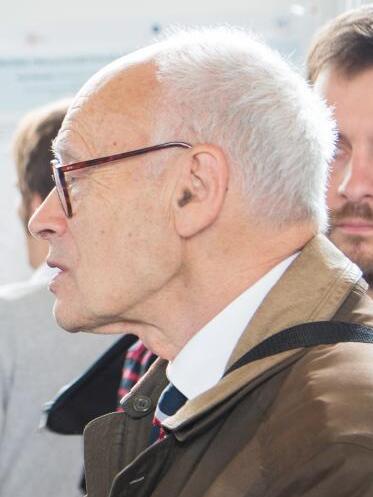
Born in 1930 in Boulogne-Billancourt, Kagan grew up in a Jewish family that hid under false names in southern France during the Second World War. He earned his PhD at the Collège de France in 1960 and built his career at Orsay, where his DIOP ligand helped found metal-based asymmetric catalysis. In 1986 he showed that a catalyst's handedness does not pass to the product in simple proportion. Left out of the 2001 chemistry prize for related work, he won this one at 95.
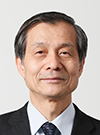
Born in 1950 in Hiroshima, Soai earned his PhD at the University of Tokyo in 1979 and joined the Tokyo University of Science in 1981. In 1990 he found a zinc reaction whose product catalyses its own formation, and in 1995 a version that also grows the excess of one mirror image. The Soai reaction now carries his name. He was out shopping near his home when the Nobel committee called.
Sources
Facts are pinned from the official Nobel Prize API. The explanations were written from these sources:
- The Nobel Prize in Chemistry 2026, popular science background (NobelPrize.org)
- Scientific background: Non-linear effects and autocatalysis in asymmetric organic synthesis (Nobel Committee for Chemistry, PDF)
- The Nobel Prize in Chemistry 2026, official summary (NobelPrize.org)
- Kenso Soai, first reactions telephone interview (NobelPrize.org)
- Henri B. Kagan (Wikipedia)
- Kensō Soai (Wikipedia)
- Soai reaction (Wikipedia)
- Non-linear effects (Wikipedia)
- Henri Kagan biography (Jewish Virtual Library)