Anne Carson: new forms from ancient fragments
Awarded to Anne Carson “for her bold and inventive oeuvre that, in playful dialogue with the classical tradition, has created new forms for contemporary literature”.
1Pick your depth
What was the 2026 Nobel Prize in Literature awarded for?
The 2026 Literature prize went to the Canadian poet and classicist Anne Carson, who takes broken scraps of ancient Greek and Latin poetry and builds new kinds of books from them: a novel written in verse, a translation full of deliberate gaps, an elegy for her brother folded into a box.
2Guess first
Only scraps survive of many ancient Greek poems: a line here, half a word there. If you translated one, would you fill in the missing parts so it reads smoothly, or leave the holes in?
How close were you?
3Learn it at ELI5
Read the transcript
A poet in Reykjavík was sweeping her kitchen floor. Her phone kept ringing, and she kept switching it off. It was the Nobel Prize calling. Old Greek poems often survive as torn scraps with holes. One scrap tells of Geryon, a red monster with wings. She turned him into a shy boy with a camera, and told his story in poems. Another book is 22 little booklets you can read in any order. The poet is Anne Carson, and she has just won the 2026 Nobel Prize in Literature.
Anne Carson is a Canadian poet who is also a teacher of ancient Greek. For most of her life she has done two jobs at once: studying very old poems and writing new ones.
Many ancient Greek poems survive only as scraps. Carson likes to take those scraps and build something completely new from them. Her most famous book, Autobiography of Red, starts from a few broken lines about a red monster with wings who gets killed by the hero Heracles. She turns the monster into a shy teenage boy who takes photos, falls in love with a boy named Heracles, and gets his heart broken. It is a whole novel, but written as poetry.
Her books rarely look like normal books. One is a long essay about love. One is a story told in 29 tangos. One, made after her brother died, is a single long folded sheet tucked inside a box. The Nobel Committee said she invents new forms for literature, and that is what it means: she keeps changing the shape of the book itself.
She was sweeping the floor
When the Nobel call came, Carson was at home in Reykjavík having tea and crackers. She had just jumped up to sweep the kitchen floor, and she kept switching off the ringing phone, as she always does. Her husband made her call back. Her advice to new readers and new writers was the same: start in the middle.
Read the transcript
In 1978, Anne Carson's brother Michael left Canada, and the two lived apart from then on. He died in Denmark in 2000. Afterwards she kept a notebook built around Catullus 101, a Roman poem for a dead brother. She annotated each Latin word, next to photos of Michael. In 2010 that notebook became Nox, her elegy for him. Nox is Latin for night. The book is one long sheet folded like an accordion, packed in a box. She often sets an ancient voice beside a modern one. In Economy of the Unlost, the Greek poet Simonides meets Paul Celan. She calls this stereoscopic vision. Carson won the 2026 Nobel Prize in Literature for new forms built in playful dialogue with the classical tradition.
Carson is a philologist and a poet, and the Nobel biobibliography says almost all her work sits where the two meet: the scholar's obsession with exact words and the poet's wish for new meaning. She has named the history of words, their etymology, as the starting point for everything she writes. Her translations from ancient Greek are treated as works of art in their own right.
Eros the Bittersweet (1986)
Her first book, reworked from her 1981 doctoral thesis, is an essay on desire in ancient Greek writing. It starts from a word Sappho made up, glukupikron, sweet and bitter at once. Carson argues that desire lives in the distance between lover and beloved, often as a triangle with a third point that keeps them apart, and that this gap is what sets a poem moving. The book first won over classicists, then essay readers, and only later poets, as it was reissued as literature in the 1990s.
Her method is to put two voices from very different times side by side and let them talk. In Eros the Bittersweet she calls this a stereoscopic vision, holding two perspectives in balance. Economy of the Unlost (1999) reads the Greek poet Simonides of Keos alongside the 20th-century poet Paul Celan. Men in the Off Hours (2000) sets the historian Thucydides next to Virginia Woolf. These pairings pull her away from the usual lyric poem built around a single speaking self.
Themes she returns to
- Desire as distance: love is strongest where something stands between two people.
- Loss and grief: a failed marriage, a father with Alzheimer's disease, a mother's death, a brother who vanished.
- The monster as the sensitive one: in Autobiography of Red the red-winged Geryon is the victim, and the hero Heracles is careless.
- Gaps and fragments: what is missing from a text is treated as part of its meaning.
- Boredom as the enemy: she has called it her arch-enemy, and she fights it with humour and sudden changes of form.
Read the transcript
In 1981, Anne Carson finished a Classics doctorate in Toronto. Her thesis was called Odi et Amo Ergo Sum, "I hate and I love, therefore I am." Reworked as Eros the Bittersweet in 1986, it starts from glukupikron, Sappho's coined word for bittersweet. Desire, Carson argues, lives in the distance between lover and beloved. In If Not, Winter, from 2002, she brings a philologist's discipline to Sappho. She keeps the Greek word order and adds nothing the text lacks. Wherever the papyrus is torn, she prints a square bracket. She has translated 10 Greek tragedies. Her Antigone, staged by Ivo van Hove with Juliette Binoche, opened in Luxembourg in 2015. The 2026 Nobel Prize in Literature honours Anne Carson alone. The Committee says her pairings of writers across time broke away from lyric poetry bound to a single narrating self.
Carson's career is a long argument that classical scholarship and avant-garde writing can be the same activity. Trained at Toronto and in Greek metrics and textual criticism at St Andrews, she taught at Calgary, Princeton, Emory, McGill, Michigan and NYU, and her books carry the marks of the seminar room: footnotes, appendices, mock interviews, glossaries. Autobiography of Red opens with an essay on Stesichoros and his adjectives, gives her own very loose translation of the Geryoneis fragments, and closes with a fictional interview with the poet. Only in the middle comes the romance itself, 47 chapters in unrhymed lines that alternate long and short.
Free with Stesichoros, strict with Sappho
Critics note a split in how she treats ancient fragments. With Stesichoros she takes huge liberties: anachronisms, a modern setting, and a love story the myth never had. With Sappho in If Not, Winter (2002) she does the reverse. She follows the Greek word order closely, avoids adding words not in the surviving text, and marks every gap with square brackets, which she called an aesthetic gesture toward the papyrological event. Reviewers called the result spare and precise, and the Cambridge Companion to Sappho (2021) judged it a defining translation of its era. The poet Bruce Whiteman dissented, saying the versions sound more like literal cribs than finished poems, and one reviewer warned that readers with no Greek might find the bare fragments frustrating.
Nox (2010) shows how far she pushes the physical book. Her brother Michael fled Canada in 1978 after a drug arrest and she never saw him again; in 2000 they arranged to meet in Copenhagen, but he died first. Nox reproduces the keepsake notebook she made afterwards: Catullus's poem 101, his elegy for a brother who also died far from home, is set out with word-by-word notes on its Latin, alongside photographs, letters and fragments of memory, all printed on one accordion-folded sheet in a box. The Nobel Committee called it as sculptural as it is literary. It is often described as her most openly personal work, though she generally discourages autobiographical readings and says she uses her own life as one set of facts among others.
Her work also leaves the page. She has translated ten Greek tragedies, and her Antigone, directed by Ivo van Hove with Juliette Binoche, toured Europe and the United States from 2015. She has written opera libretti, including The Mile-Long Opera (2018) with the composer David Lang, and works closely with Robert Currie on book design and performance. The Committee credits these collaborations with visual artists, choreographers and directors for her outsized influence on the international art and literature scene since the 1990s.
Why this prize mattered
- It honoured a writer whose main material is the ancient world, and who treats scholarship as a creative act.
- It rewarded genre-crossing as an achievement in itself: verse novels, fictional essays, box-books, comics and plays all count as her oeuvre.
- It recognised translation, often treated as secondary work, as central to a Nobel-level body of writing.
- It closed a long run of near-misses: she was longlisted for the 2018 New Academy Prize and had been tipped as a likely Nobel laureate for years.
A book that is really a box
Nox, her elegy for her brother, has no ordinary pages. It is one long sheet, folded like an accordion and packed in a box, reproducing the handmade notebook she kept after his death: a Roman poem, notes on each of its Latin words, photographs and letters. Nox is the Latin word for night.
4Check yourself
What did Carson build Autobiography of Red from?
In her Sappho translation If Not, Winter, what do the square brackets show?
What is unusual about the physical form of Nox?
Key terms
- Classics
- The study of ancient Greek and Roman language, literature and history. Carson has taught it at universities since 1979.
- Philology
- The close study of words and texts, including where words come from. Carson names etymology as the starting point of all her work.
- Fragment
- A piece of an ancient text that survives only in part, often on torn papyrus or as a quotation in another author.
- Glukupikron
- Sappho's made-up Greek word for sweet-bitter. It gives Eros the Bittersweet its title and its central idea: desire as pleasure and pain at once.
- Verse novel
- A full-length story told in poetry. Autobiography of Red carries the subtitle A Novel in Verse.
- Elegy
- A poem of mourning. Catullus 101, for the Roman poet's dead brother, is the elegy at the centre of Nox.
- Stereoscopic vision
- Carson's own phrase from Eros the Bittersweet for holding two perspectives in balance at once, her basic method.
The laureate
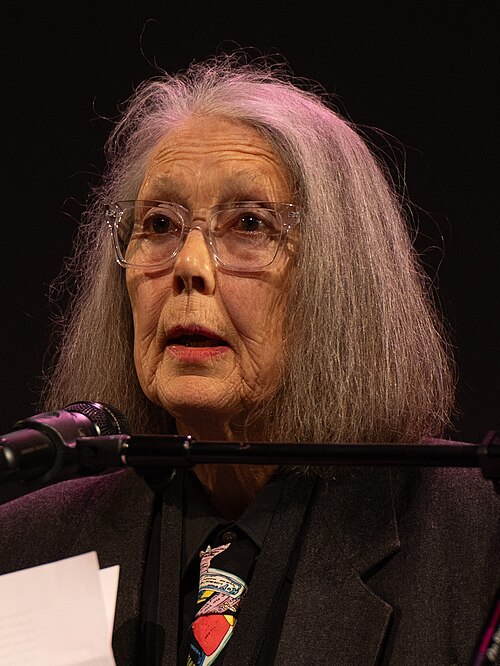
Born on 21 June 1950 in Toronto, Carson earned three degrees at the University of Toronto, finishing a PhD in Classics in 1981. She has taught ancient Greek and Latin at universities in Canada and the United States since 1979, became an Icelandic citizen in 2022, and lives in Reykjavík with her husband and collaborator, the artist Robert Currie.
Sources
Facts are pinned from the official Nobel Prize API. The explanations were written from these sources:
- The Nobel Prize in Literature 2026, press release (NobelPrize.org)
- The Nobel Prize in Literature 2026, biobibliography (NobelPrize.org)
- Anne Carson, facts (NobelPrize.org)
- Anne Carson, first reactions interview (NobelPrize.org)
- Anne Carson (Wikipedia)
- Autobiography of Red (Wikipedia)
- If Not, Winter (Wikipedia)
- Catullus 101 (Wikipedia)
- David Biespiel on Nox (National Book Critics Circle)