László Krasznahorkai: finding beauty in the apocalypse
Awarded to László Krasznahorkai “for his compelling and visionary oeuvre that, in the midst of apocalyptic terror, reaffirms the power of art”.
1Pick your depth
What was the 2025 Nobel Prize in Literature awarded for?
The 2025 Literature prize went to the Hungarian writer László Krasznahorkai for a body of work built from long, winding sentences that can run for pages with almost no full stops. His novels picture worlds sliding toward collapse, yet they keep insisting that art and beauty still hold their power in the middle of the ruin.
2Guess first
Most quotable novels are full of short, punchy sentences. Krasznahorkai does the opposite: single sentences that run for pages with almost no full stops. Why would a writer make reading this demanding on purpose?
How close were you?
The citation says his work reaffirms the power of art in the midst of apocalyptic terror. How can stories about collapse and ruin be an argument FOR art?
How close were you?
3Learn it at ELI5
Read the transcript
In Kyoto, Japan, a snow-white heron stands very still in a river. It waits for a fish. Crowds walk past, and nobody sees it. A writer from Hungary opened a book with that heron. To him, the bird is like an artist nobody notices. His sentences flow on like a river, sometimes for pages, with almost no full stops. His stories are often about towns slowly falling apart. Yet beauty and art still shine through. He is László Krasznahorkai, winner of the 2025 Nobel Prize in Literature.
László Krasznahorkai is a Hungarian writer, born in 1954, who won the 2025 Nobel Prize in Literature. He is best known for an unusual look on the page: his sentences can wind on for pages, sometimes a whole chapter, with almost no full stops.
His stories are often dark. They are set in run-down villages and towns where things are quietly falling apart and a feeling of dread hangs over everyone. Yet the books are not only bleak. They keep pointing to moments of beauty and to the power of art, even when the world around the characters seems to be ending. Readers also find him surprisingly funny.
Satantango
His first novel, Satantango (1985), follows the trapped residents of a collapsing rural community waiting for two men who may save them or cheat them. It later became a famous seven-hour film by his friend, the director Béla Tarr, and helped make Krasznahorkai one of the most admired living writers.
Read the transcript
On 9 October 2025, László Krasznahorkai heard the Nobel news at a sick friend's flat in Frankfurt. "This is more than a catastrophe," he said, echoing Samuel Beckett. He had planned to spend the day registering a new address. His first novel, Satantango, from 1985, is set on an abandoned collective farm. The villagers wait, until Irimiás, believed dead, walks back in and cons almost all of them. Its 12 chapters move like a tango, 6 steps forward and 6 steps back. Béla Tarr filmed it in 1994. In the next novel, a circus brings a giant whale carcass to a small town, and violence spreads. He is the second Hungarian to win the Nobel Prize in Literature, after Imre Kertész in 2002.
Krasznahorkai's signature is the long sentence. His prose unspools in long, winding sentences that can run for pages with very few full stops, a flow his translator George Szirtes once described as a slow lava flow of narrative. The form is not decoration. The unbroken movement pulls you inside a character's circling thoughts and a world that never quite settles or resolves.
Worlds on the edge of collapse
From Satantango (1985) to The Melancholy of Resistance (1989), Krasznahorkai writes communities sliding toward ruin. In The Melancholy of Resistance, a travelling circus brings a giant stuffed whale to a Hungarian town, and the strange spectacle helps tip the place into violence and anarchy. Susan Sontag called him the contemporary Hungarian master of apocalypse.
The themes he returns to
- Decay and collapse: villages, towns, and whole social orders quietly coming apart.
- Dread and waiting: ordinary people stuck in time, hoping for a rescue or a sign that may never come.
- Faith and meaning in a world that offers little of either, often carried by a dark, deadpan humour.
- Beauty and art as the thing that survives, especially in his later, calmer books inspired by his travels to China and Japan.
That last theme is the key to his Nobel citation. The Swedish Academy praised an oeuvre that, in the midst of apocalyptic terror, reaffirms the power of art. Later works such as Seiobo There Below (2008) turn east and slow down, tracing how the sacred and the beautiful keep reappearing across cultures and centuries, even as everything else falls away. The prize rewarded both halves of his work: the dread and the beauty.
Read the transcript
László Krasznahorkai opened his Nobel lecture saying he had meant to speak about hope. His stores of hope had run out, so he spoke about angels, with no wings and no message. Anders Olsson of the Nobel Committee calls his long, winding sentences without full stops his signature. Herscht 07769, from 2021, is a single sentence of about 400 pages, set in Thuringia against Bach's legacy. The Committee places him in a Central European line from Kafka to Thomas Bernhard. Susan Sontag called him the master of the apocalypse. Journeys to China and Japan gave him a calmer tone. Seiobo There Below, from 2008, numbers its 17 stories with the Fibonacci sequence, up to 2584. They follow craftsmen and onlookers beside works of art coming into being. The 2025 citation praises an oeuvre that, in the midst of apocalyptic terror, reaffirms the power of art.
Krasznahorkai belongs to a Central European lineage the Nobel committee traced from Kafka through Thomas Bernhard, marked by absurdism and grotesque excess. His debut, Satantango (1985), appeared in Hungary before the fall of communism and reads as a parable of a stranded society. Its twelve chapters are built like a tango, six steps forward and six back, each one a single unbroken paragraph. The closed, circling structure is the meaning: a community that cannot move forward and keeps returning to where it began.
Sentences that go to incredible lengths
When Krasznahorkai won the Man Booker International Prize in 2015 for his body of work, the judges praised sentences of incredible length that go to incredible lengths, their tone switching from solemn to madcap to quizzical to desolate. The technique is not difficulty for its own sake. By withholding the full stop, he keeps thought, dread, and perception suspended, so the reader experiences the search for meaning rather than being handed it.
From the late 1980s his work widened. Journeys to China and Japan produced a more contemplative, finely calibrated tone, and books such as Seiobo There Below (2008) follow the recurrence of beauty and the sacred through art across many times and places. This is where the citation's claim becomes clear: against a backdrop of terror and ruin, the made object, the painting, the performance, the act of attention, holds its power. W. G. Sebald praised the universality of his vision, and the critic James Wood wrote that his books get passed around like rare currency.
“His prose has developed towards a flowing syntax with long, winding sentences devoid of full stops that has become his signature.”Anders Olsson, chair of the Nobel committee, October 2025
The choice was not without debate. Krasznahorkai is, by common agreement, a demanding writer, and some readers find the dense, unpunctuated pages forbidding. Critics framed the award as unusually experimental for the prize, yet argued that it felt fitting for an anxious age. The novelist Hari Kunzru caught the split, calling the work bleak and difficult while also, in his words, curious, playful and very funny. Much of that reach abroad depends on translation, a reminder of how much Nobel-level world literature passes through translators before it ever finds an English reader.
Why this prize mattered
- It honoured a genuinely difficult, experimental writer, which is uncommon for the prize; one critic called the choice unusually experimental yet perfectly timely for an unstable world.
- It made Krasznahorkai only the second Hungarian laureate in literature, after Imre Kertész in 2002.
- It recognised a body of work whose global reach rests on translation, above all George Szirtes and Ottilie Mulzet, who carried his Hungarian sentences into English.
- It validated a vision that is bleak and funny at once, refusing easy comfort while insisting that art still matters.
Twelve chapters that dance a tango
Satantango is built like its title. Its twelve chapters move six steps forward and six steps back, the shape of a tango, and each chapter is a single unbroken paragraph with no line breaks. The form mirrors the trapped community inside it, circling in place and never quite moving on.
4Check yourself
What is László Krasznahorkai best known for in his writing style?
What mood and subject run through novels like Satantango and The Melancholy of Resistance?
According to the Nobel citation, what does Krasznahorkai's work reaffirm in the midst of apocalyptic terror?
Key terms
- Apocalyptic terror
- A phrase from the 2025 citation. Krasznahorkai's settings feel as if the world is ending or breaking down; Susan Sontag dubbed him the master of apocalypse.
- The long sentence
- Krasznahorkai's trademark form: sentences that wind on for pages with very few full stops, which the Nobel committee called his signature.
- Satantango
- Krasznahorkai's 1985 debut novel about a collapsing rural community, built in twelve single-paragraph chapters shaped like a tango. Adapted into a seven-hour film by Béla Tarr.
- The Melancholy of Resistance
- His 1989 novel in which a circus brings a giant stuffed whale to a Hungarian town, helping tip it into violence and anarchy.
- Béla Tarr
- The Hungarian filmmaker and close collaborator who adapted several of Krasznahorkai's books, including the seven-hour Satantango (1994) and Werckmeister Harmonies (2000).
The laureate
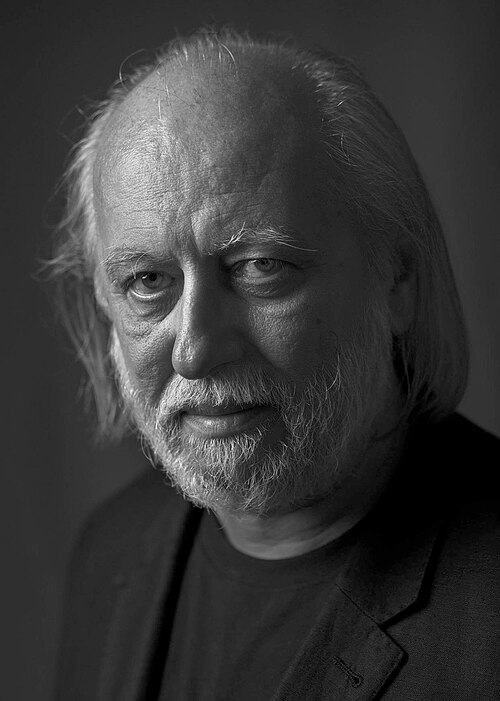
Born in 1954 in Gyula, in southeast Hungary, Krasznahorkai is a novelist and screenwriter who writes in Hungarian. He is the second Hungarian winner of the literature prize, after Imre Kertész in 2002, known worldwide for novels such as Satantango and The Melancholy of Resistance and for his long partnership with the filmmaker Béla Tarr.
Sources
Facts are pinned from the official Nobel Prize API. The explanations were written from these sources: